Empty Rooms, Loud Villains: The Quiet Art of Making a Space Feel Evil

Photo: empty minimalist dark room single chair anime background art moody, via img.freepik.com
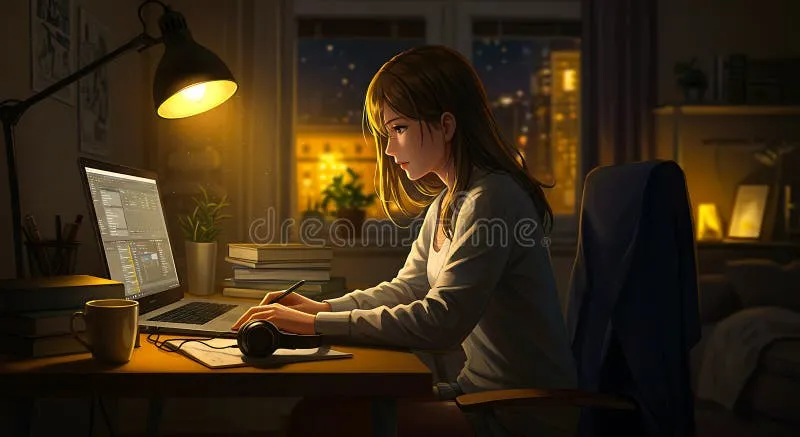
Walk into any anime protagonist's bedroom and you'll learn everything about them before they say a word. There's a poster half-peeling off the wall, a shelf buckling under light novels, a desk drowning in energy drink cans and half-finished homework. It's cozy chaos. It's life.
Now walk into the villain's space. There's a chair. Maybe a window. The walls are the color of nothing at all.
That contrast isn't an accident, and it isn't laziness on the part of the art department. It's one of the oldest tricks in anime's visual vocabulary, and background artists have been quietly wielding it for decades.
The Hero's Mess Is a Love Letter
In anime production, the background art team — the bījutsu (art) staff — works hand in hand with the director to encode personality into environments. A cluttered room tells you the character inside it has desires, hobbies, attachments. Clutter is proof of wanting.
Think of the warmth that radiates from a well-loved space in a slice-of-life series. Every knickknack on the shelf is a sentence in a biography. American audiences got a crash course in this language through films like Your Name and the Ghibli catalog, where kitchens and classrooms feel lived-in down to the scuff marks on the floor.
The takeaway is simple: heroes have stuff because heroes have relationships. With people, with objects, with the world.
Negative Space as a Character Sheet
So what does it mean when a character's environment refuses to hold anything?
It means the production team is telling you, without dialogue, that this person has cut themselves off. A bare apartment in a psychological thriller isn't minimalist chic — it's a visual confession. The character has no attachments, or has burned them, or is in the process of burning them.
Color scripts do heavy lifting here too. Hero spaces lean warm: amber lamplight, cream walls, wood tones. Villain spaces trend toward desaturated blues, sickly greens, or flat monochrome. The palette itself becomes a moral judgment.
And then there's stillness. Background artists talk about "emotional set dressing" — the deliberate placement (or deliberate absence) of objects to steer how a scene feels before anything happens. A completely still room, drawn with obsessive precision but containing nothing alive, creates a low hum of dread. Nothing is wrong. That's exactly what's wrong.
Case Studies in Emptiness
You don't have to look hard to find this pattern in the shows US fans binge every weekend.
Psychological thrillers are the obvious playground. When a calculating antagonist's lair is rendered as a vast, echoing void with a single desk and a wall of monitors, the message is clear: this person relates to other humans as data points, not neighbors. The room is a diagram of their empathy.
Even action-forward series use it. The moment a story wants you to suspect a character, their personal space tends to shed its clutter. A once-messy room shown suddenly immaculate is anime's version of a horror movie violin sting. The tidiness is the plot twist.
On the flip side, look at redemption arcs. When a former antagonist starts accumulating objects — a plant, a mug, a photo — the background team is telling you the person is healing. Fans on Reddit and Tumblr have built entire threads around spotting the exact frame where a character's room starts to look inhabited again. The fandom noticed. They always do.
The Craftsmanship of Nothing
Here's the part that surprises people: drawing an empty room is harder than drawing a full one.
A cluttered space hides imperfections in its chaos. A bare room exposes everything — every perspective line, every texture choice, every subtle gradient in the wall's shadow. There's nowhere for the eye to rest, so there's nowhere for the art to hide. Background painters spend enormous effort on surfaces that most viewers will never consciously register: the grain of a concrete wall, the exact temperature of light through an uncurtained window.
Veteran art directors describe this as designing the emotion first and the furniture second. The room's job isn't to look realistic. It's to make your stomach drop two seconds before the script does.
Why It Works on Us
There's a reason this trick never gets old, even for viewers who've seen it a hundred times. Humans read spaces the way we read faces. A warm, messy room triggers the same instincts as a smiling face. An empty, still room reads as a blank stare — and our brains are wired to find blank stares threatening.
Anime, perhaps more than any other animation tradition, trusts its audience to pick up on this. No exposition dump explains that the villain is lonely. The walls already told you.
So the next time a new series drops and you meet its antagonist, do yourself a favor: pause on the establishing shots of their space. Count the objects. Check the color temperature. Notice the silence built into the walls.
Somewhere in a production studio, a background artist placed every one of those absences with surgical care. The scariest thing in the room was always what wasn't there.