The Empty Room Speaks: How Anime Uses Silence Better Than Anything on American TV
There's a scene you've probably watched a dozen times without realizing what it was doing to you. Two characters sit on a train. The camera lingers on the window. Rain streaks the glass. Nobody talks. Nobody moves. The shot holds for eight full seconds — an eternity in animation terms — and somehow, those eight seconds carry more emotional weight than the entire episode of dialogue that came before.
That's not an accident. That's ma (間), and it might be the single most underappreciated tool in anime's storytelling arsenal.
What Exactly Is 'Ma'?
Roughly translated, ma means gap, pause, or interval — but the translation undersells it. In Japanese aesthetics, ma isn't empty space. It's charged space. It's the beat between two notes in a shamisen performance, the negative space in a brush painting, the breath before a confession scene.
Western storytelling traditions, particularly American ones, tend to treat gaps as problems to be solved. Network notes famously demand that scenes "move faster" and cut anything that doesn't advance the plot. Sitcoms panic at the thought of a laugh track gap. Animated features in the Disney tradition fill every frame with motion, background gags, and sassy sidekick commentary.
Anime, shaped by different cultural instincts, learned a long time ago that silence can do work that dialogue never could.
Yasujiro Ozu's Ghost Lives in Modern Anime
If you want to trace the lineage, start with Yasujiro Ozu — the legendary film director whose tatami-level shots and patient, static compositions became a national grammar. Ozu would hold a shot on an empty hallway long after the character left, letting the room absorb the emotion of the scene.
Modern anime absorbed that DNA wholesale.
Studio Ghibli built entire sequences around it. Hayao Miyazaki's famous "ma moments" — the rain splashing on a puddle in My Neighbor Totoro, the quiet tea-pouring scenes in Spirited Away — exist specifically to let audiences exhale and feel something before the story barrels forward. Kyoto Animation took the technique to devastating effect in Violet Evergarden, where wordless shots of an empty chair or a held breath do the heavy lifting that a lesser show would hand to a monologue.
And then there's Oshi no Ko, Frieren: Beyond Journey's End, and Bocchi the Rock! — three of the most talked-about recent imports in the US — each using stillness as a punchline, a gut-punch, or both. Frieren in particular is practically a masterclass in ma: a show about an elf with a thousand-year lifespan that communicates loneliness through long, quiet shots of landscapes nobody else remembers.
Why American Animation Flinches at the Pause
To be fair to Western animation, the fear of dead air has structural roots. US animation was built on tight budgets, broadcast schedules, and the need to hold children's attention across commercial breaks. Every second costs money, so every second needs to "earn" its place.
The result is a style that treats stillness like a bug rather than a feature.
But something's shifting. American audiences who grew up on anime are now running the studios. Arcane — made in France, sure, but pitched squarely at the Western audience — uses lingering silences to remarkable effect. Spider-Verse lets frames breathe. Even mainstream animated series are discovering what anime knew decades ago: audiences don't need to be entertained every single frame. Sometimes they need to be held.
The Pause Is the Punchline
Here's the counterintuitive part: silence in anime isn't just for drama. It's one of comedy's sharpest weapons too.
Watch any episode of Nichijou or Saiki K and you'll notice the best jokes land not on the gag itself but on the dead-eyed pause afterward. The blank stare held three seconds too long. The cutaway to a completely unrelated empty landscape. It's the same principle as a well-timed beat in stand-up comedy — the setup creates tension, the pause creates anticipation, and the payoff detonates.
American animation actually knows this instinctively. The long, uncomfortable silences in SpongeBob are some of its funniest moments. But anime has institutionalized the technique across genres in a way Western animation still hasn't.
Learning to Sit Still
For US viewers raised on a steady diet of rapid-fire quips and MCU pacing, anime's silences can feel uncomfortable at first. That discomfort is the point. It's the sound of your viewing habits being rewired.
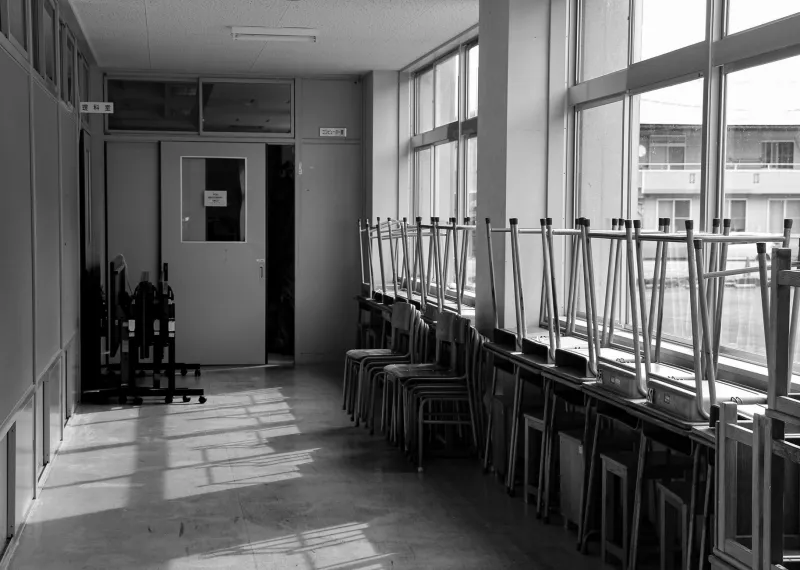
So the next time an anime holds a shot on an empty classroom, a cooling cup of tea, or a character just... breathing — don't reach for the skip button. Lean in. Something is happening in that frame, even though nothing is happening in it.
The emptiest rooms in anime are the fullest ones. You just have to be quiet enough to hear them.